- Rating
- —/10
- Read
- —
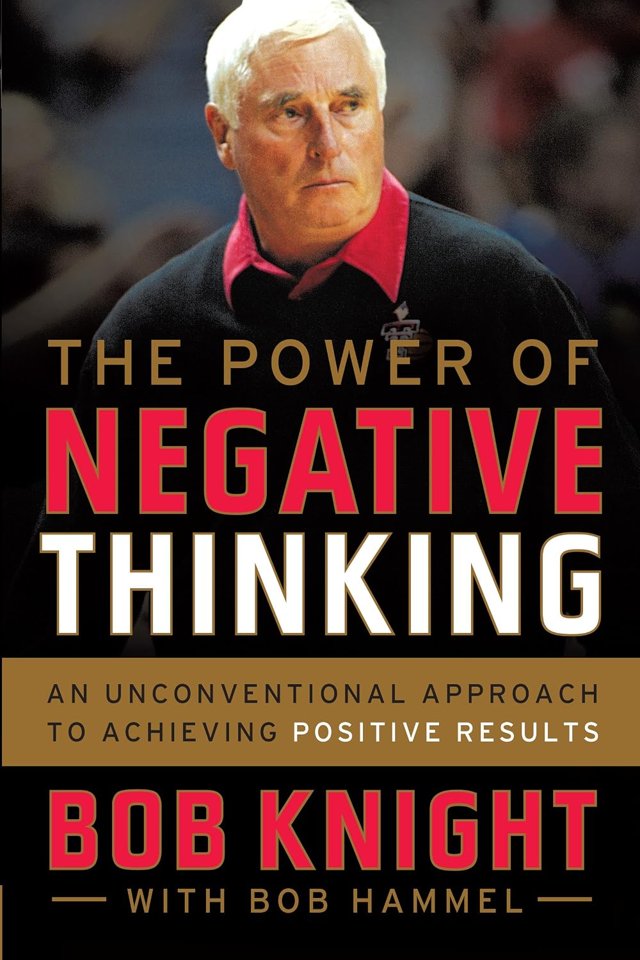
Bob Knight won three national championships at Indiana, and this book is his case against the culture of positive thinking. His argument is that optimism on its own leads people to skip preparation. Winning, in basketball and anywhere else, comes from anticipating what can go wrong, planning for it, and making fewer mistakes than the other side. Being “negative” in his sense isn’t pessimism. It’s realism that does the work optimism assumes will take care of itself.
Highlights
Paying attention to the downside is a difficult but essential quality for achieving long-term success in any occupation or family situation.
I’m saying that being alert to the possible negatives in any situation is the very best way to bring about positive results.
Planning beats repairing.
I always looked at upcoming games and saw all kinds of ways we could lose to our next opponent, some of them—maybe most of them—things that had nothing to do with the opponent at all but involved what we had to correct about our own execution to keep from beating ourselves.
As I looked ahead to every game and every season, my first thought was always: What vulnerabilities do we have and what can we do to minimize them, to get around them, to survive them—and give ourselves a better chance to win?
Victory favors the team making the fewest mistakes.
As a coach, you have to understand, it’s not the development of your offense or the development of your defense that will make you a consistently winning team; it’s the elimination of mistakes—it’s getting rid of those things that amount to a deal-breaker in the game of basketball:
Before you can inspire your players to “win,” you have to show them how not to lose.
So many negative things can be done in the game of basketball that you have to address them, in terms of those four words that are at the heart of this negative-to-achieve positive manifesto: We have no chance to win if… We’re going to get our ass beat unless… We can’t play this way… This is something that you don’t do… and win.
We won a lot of games, a lot of championships, over the years by polishing the things that our own team did well, but in our preparations always focusing, above all, on preventing losing. That included locking in on what the other team did well, what the other team could do to beat us
Discipline is recognizing what has to be done, doing it as well as you can do it, and doing it that way all the time.
The difference between knowing what you should do and repeatedly trying to do it is the same as is pointed out in another maxim of mine: Having the will to win is not enough. Everyone has that. What matters is having the will to prepare to win.
The positive thinker tends to enjoy a big win, to congratulate himself and his staff and his players and generally revel in the fact that he and his team won! The negative thinker has already forgotten that one and gone to work on the next game.
Success is a grind. It’s perseverance; it is operating at a high level of performance on a constant basis.
The good don’t let up and neither do the great. Jim Collins, the business guru, has observed that “good is the enemy of great” because if we’re too easily satisfied, we lose our edge.
Coaches tell me all the time, “You don’t enjoy the wins like you suffer the losses,” and there’s a lot of truth to that. You lose, the next day you can’t put it away, you win and it’s usually easy because you’re worried about the next one.
The first job that we have today is putting yesterday aside to be remembered later. (Tony LaRussa, World Series Champion 2011)
When you start gloating over your victories (or your profits), you’re about to get your head handed to you. As one wise observer put it: “Early failure is usually better than early success, because the lesson in humility lasts a long time and makes you more effective over the long term.
I tried to teach my son Pat a lesson once when he was really young—maybe eight or nine—and he talked me into playing pool against him. He really had no chance given our respective skills, but I didn’t like how carelessly he was playing, so I finished him off pretty fast. He started to rack the balls up to play again, and I just walked away, saying, “No, Pat, I don’t want to play any more until you get better. Sometimes in sports or life, you just get one shot at it and you’d better be ready. You sure weren’t ready today.” Several weeks later, we played again, and Pat actually beat me. I was stunned. I thought we were just starting an hour or so of playing, but he turned, walked up the stairs, and said, “No, Dad, sometimes you just get one chance.” Lesson learned!
My list of the most irritating platitudes starts with someone looking at a very messy situation and saying nonchalantly, “Oh, well, the sun will come up tomorrow.” My response: Yeah, and it will flash brand-new daylight on the same old mess unless something is done to clean it up. I always feel like firing back at the sun-believers, “It’s not God’s dependability that’s the question here; it’s yours.” The one-word question to keep in mind
When these mindless, optimistic paeans to patience are thrown around is: Why? “Everything will be better tomorrow.” Why? “Everything will work out for the best.” Why? “We’ll get ’em next time.” Why?
On offense alone: A major part of my coaching was getting across the idea that—just as the great Chinese general Sun Tzu said—“A military operation involves deception.
I hope your stockbroker operates the same way—ruling out the risky moves and finding the low-hanging fruit that has the highest percentage of success. (Of course, I like the investment contrarians who don’t follow the crowd when stock prices have become inflated. This is another example of “negative” judgment that leads to very positive results in your portfolio.)
The successful person has to be able to change his mind when something isn’t working and try to bail out or possibly find a more creative solution.
That’s why as a coach I always tried to cut away the mistakes, because each time we had the ball was a limited resource, and we needed to get it in the basket without wasting the chance to take the shot.
The point is the negative thinker always knows there is a chance that he can get beat, so he works to make that as unlikely as he can.
One of the most important statements a coach can make to himself is: I don’t know, but I’m going to find out.
Asking questions is the essence of learning.
Knowing what you don’t know is one of the most important lessons in life.
I have had six honest serving men. They taught me all I knew. Their names are What, Where, When, How, Why, and Who.
A Roman poet named Lucretius wrote in the century before Christ: A fair-sized stream seems vast to one who until then Has never seen a greater; so with trees, with men. In every field each man regards as vast in size The greatest objects that have come before his eyes.
We had to work at doing things that enabled us to win, and eliminate the sloppiness or risky plays that could beat us in a close game.
If you’re going against a really good team, maybe even a more talented team—in business, a bigger, better-known, better-financed company—you’d better have something a little different in your plans.
The negative-conscious person has a great opportunity to capitalize on how vulnerable a lot of people are because of their illusory positive thinking about things they don’t understand or actions they are incapable of performing.
Being able to self-analyze and be self-critical is very important. You can accomplish surprising things if you ask questions and consult others about areas where you need to improve.
Understanding limitations—your players’ or your own—is the first step toward overcoming them.
There’s one other phrase I love along these lines, and it came from Ronald Reagan, the president with the characteristic smile—the amiable fellow called the “Great Communicator,” whose byword in diplomatic negotiations was: “Trust, but verify.
(I prefer the adage When you’re in a hole, stop digging.)
Dumb plays are usually followed by dumber plays.
Success increases our self-assurance. Faith in ourselves is a good thing, of course, but too much of it can make us believe we don’t need to change anything. In the article, Gino and Pisano listed “overconfidence bias” as the second of three impediments that success can put in front of any enterprise.
We almost always work at finding why we lost, or failed. Too rarely do coaches think about why they won, but it’s an equally important, equally instructive question.
Worry has lost a lot fewer games than over-confidence has.
A very simple philosophy: Find ways to let the other side beat itself.
Practice is the best of all instructors.
Publilius Syrus works: I have often regretted my speech, never my silence. That’s a better way of saying “Go to shut-up school.” Of all, this one from Publilius may be my favorite: It is a bad plan that admits of no modification.
Every successful endeavor starts with a plan. Know that some things will go wrong. Adjust is one of the great words in the English language. Always, no matter how meticulously something has been thought out and planned, an effective leader has to be ready and willing to adjust.
Franklin D. Roosevelt’s first inaugural address twice used a negative-image word to—memorably and historically—make his own positive point: The only thing we have to fear is fear itself. John F. Kennedy’s inaugural address is most remembered for: Ask NOT what your country can do for you—ask what you can do for your country.
“Those who cannot remember the past are condemned to repeat it
Water shapes its course according to the nature of the ground over which it flows; the soldier works out his victory in relation to the foe whom he is facing. Therefore, just as water retains no constant shape, so in warfare there are no constant conditions. He who can modify his tactics in relation to his opponent and thereby succeed in winning may be called a heaven-born captain.
Sun Tzu’s primary axioms: avoid strength, strike at weakness, go around the enemy, use deception not power to overcome, seize something the enemy must seek to recover, and induce the enemy to attack well-prepared positions and be defeated.
Lincoln said an important thing for any leader to understand is: Do what you think is best—after, I’m presuming, you’ve thoroughly thought out and researched the problem.
Two bulls, one young and one old, looked down from a hilltop onto a meadow full of prancing young cows. The young bull snorted and said, “Out of my way, old man. I’m gonna run right down there and service me one.” And the old bull answered: “Patience, son. Walk down and service them all.
Mistakes determine the outcome of far more games than great plays do.
The key to consistent execution is to be demanding. The word demand is important in leadership success. Demand is a negative word, since it assumes a critical lack of action or production. The best teachers and the best leaders are the most demanding people I’ve known—intelligently demanding. Don’t demand of people what they can’t do. Demand what they can do.
In coaching, you have to think negatively to think defense over offense, because you’re saying—maybe even admitting—“We can’t count on outscoring them; we have to figure out a way to stop them.”
Having the will to win is not enough. What matters is having the will to prepare to win.
How hard you’ve worked at preparation gives you the will to win. If you’ve prepared properly, you have the extra motivation to get a satisfactory return on your own investment of work, sweat, and focus.
Moral: Even the will to prepare to win doesn’t mean your opponent isn’t preparing, too. And if he is and you aren’t, the advantage is his.
Elimination of mistakes is more important than the will to win.
Handling negative situations in a way that brings positive outcomes is itself an admirable art.
Sherlock Holmes was fond of saying, “Many people look but few see.” A great word is observation. See what’s there. Be observant.
A fool and his money are soon parted. It’s true, and you’ve got to be smart enough not to be the fool.
The word no isn’t a bad way to stall when hit with a lot of sudden proposals. You can always change no into yes, and usually make people happy, but it’s a lot harder—sometimes too late—to change yes to no. From our own experiences, how many times do you think people wished they could change yes into no?
Good things come to he who waits. If he works like hell while waiting.
An ounce of prevention is worth a pound of cure.
If at first you don’t succeed try, try again. And then find someone to help you.
A bird in the hand is worth two in the bush.
A good beginning makes a good ending. If accompanied by a very good middle.
A chain is only as strong as its weakest link. When you have one, it’s time to substitute.
Hindsight is 20/20. And foresight is even better.
Take the path of least resistance.
You can lead a horse to water, but you can’t make him drink. Maybe you haven’t done enough to make him thirsty.
The light at the end of the tunnel… … is a lousy thing to rely on for vision.
Money is the root of all evil. But poverty isn’t a whole lot better.
You can’t have your cake and eat it, too. Unless you’re the biggest, meanest guy at the party.
Adage: Better to remain silent and be thought a fool than to speak out and remove all doubt. (Lincoln)
Adage: Character is what you do when no one is looking.
Fundamentals. Fundamentals. Fundamentals. Fundamentals eliminate ways to fail, ways to
The greatest fundamentalists—in coaching, in warfare, in theology, in business—were and always have been more concerned about losing than about winning. One of the often-criticized coaching axioms is “playing not to lose, rather than to win.” For me, playing not to lose is actually the best way to win.